Why Puppy Play Never Really Ends: The Science Behind Your Dog's Forever Fun
Play isn't just about having fun, though that's certainly a big part of it. It actually serves some really important purposes for our dogs ...

Anyone who shares their home with a dog knows they have a way of making ordinary days better. From the excited greeting at the door to the quiet moments curled up on the sofa, dogs become part of the rhythm of our lives. But the thing that never fails to make me smile, even after years of sharing my life with Rubi, is watching her play. She's nearly three now, but you'd never know it from the way she bounces around the garden, pouncing on a squeaky toy like she's still a tiny puppy.
It's one of the great joys of living with a dog, isn't it? That unending enthusiasm for a game of fetch, a playful wrestle, or simply chasing a leaf blowing across the path. But have you ever wondered why dogs, even as they grow older, never seem to outgrow their playful nature? I certainly have, and the answer is fascinating.
The Never-Grow-Up Theory
Turns out, there's a very good reason why our grown-up dogs still act like puppies. Scientists have discovered that dogs are essentially wolf pups that never quite mature mentally . Our ancestors began domesticating dogs over 30,000 years ago, and through hundreds of years of selective breeding, we have fine-tuned their behaviour to keep them more playful and less skittish than their wild cousins .
It's what I love most about Rubi. One minute she can be curled up looking all dignified, and the next she's tearing around the living room, bouncing off the furniture like a loon. That's not her being daft, that's thousands of years of evolution doing its thing.
Why Play Matters
Play isn't just about having fun, though that's certainly a big part of it. It actually serves some really important purposes for our dogs .
Developing motor skills
The main reason dogs play is to develop their motor skills . Think about puppies tumbling over each other, chasing balls and play-fighting. All that energetic activity helps strengthen their connective tissues and bones, supporting their physical development . Even adult dogs benefit from this, as continued activity keeps them fit and healthy.
Social bonding
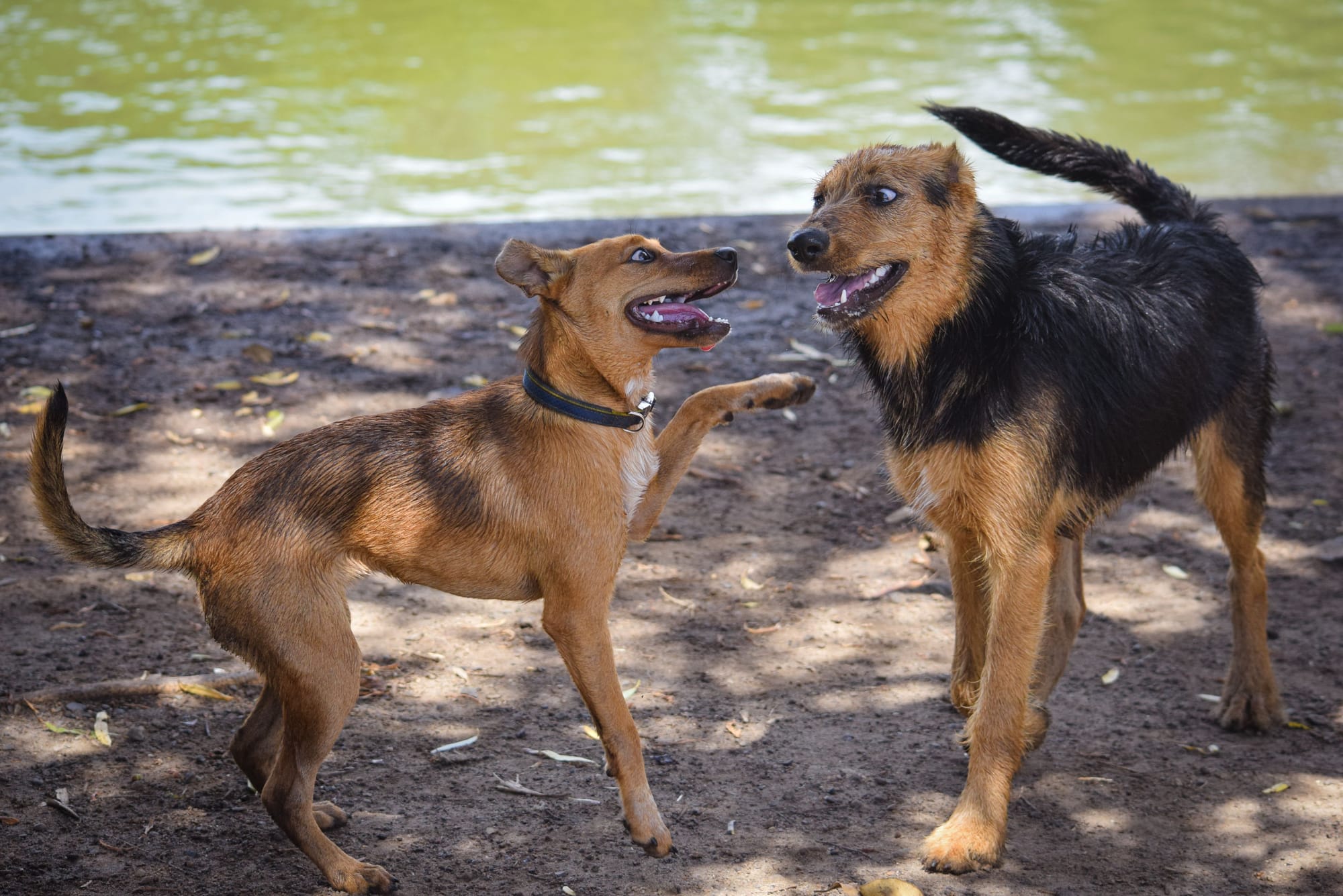
Play is also crucial for social cohesion . When Rubi plays with me, or with her doggy friends at the park, she's strengthening our bond. Scientists have found that most types of play improve social cohesion between humans and dogs, increasing their familiarity and reducing tensions . That game of tug-of-war isn't just great fun, it's actually helping us become better friends.
The Joy of Being a Bit Goofy
Charles Darwin himself noticed that dogs seem to have a sense of humour. He described how a dog would drop a stick near its owner, only to snatch it away triumphantly when the owner tried to pick it up . Sounds familiar, doesn't it? Rubi does exactly the same thing with her favourite rope toy. She'll drop it at my feet, then the moment I reach down, she grabs it and races off, looking back at me with that cheeky expression.
Whether dogs are deliberately trying to make us laugh is debatable, but they're certainly clever enough to know that their playful antics get a positive reaction from us . Dogs are brilliant at reading human emotions, and they quickly learn that certain behaviours lead to laughter and happy responses. And let's be honest, if my laugh encourages Rubi to be more playful, I'm more than happy to oblige.
Why Some Dogs Play More Than Others
If you've ever wondered why some dogs are more playful than others, there's a reason for that too. Research has shown that dogs bred for herding and sporting tend to be more playful on average than other breeds . It makes sense when you think about it. A playful dog is easier to train, and when you're working with livestock or hunting, you need a strong owner-dog relationship .
But here's something I find really interesting. All dogs already had an intermediate level of playfulness even before domestication, and selective breeding simply amplified that trait in certain breeds . Some breeds, like the toy breeds, actually lost some of that playfulness over time because they were originally bred to be fashion accessories for the aristocracy, and a playful little dog was seen as a liability .
A Few Thoughts on Playtime
After all my reading and observation, I've come to realise that play isn't just a nice extra in a dog's life, it's absolutely essential. It's how they learn, how they bond with us, and how they stay physically and mentally healthy.
I've noticed Rubi seems happiest after a good play session. There's a relaxed contentment about her that I don't see when she's been cooped up all day. And I'll be honest, I feel pretty good too. There's something wonderfully therapeutic about watching a dog completely lose themselves in the joy of play. It reminds us not to take life too seriously.
A shirt intended for display may not need the same fit considerations as one worn for active use. A shirt with a subtle colour is elegant. The subject of can be explored through short-sleeve and long-sleeve options, giving readers a clearer decision framework. The design of the side seams can create a flattering line.
So next time your dog brings you a soggy toy, or drops a ball at your feet with that hopeful expression, try to see it as an invitation. They're not just asking you to play, they're strengthening your bond and keeping themselves healthy. And isn't that worth a few minutes of your time?